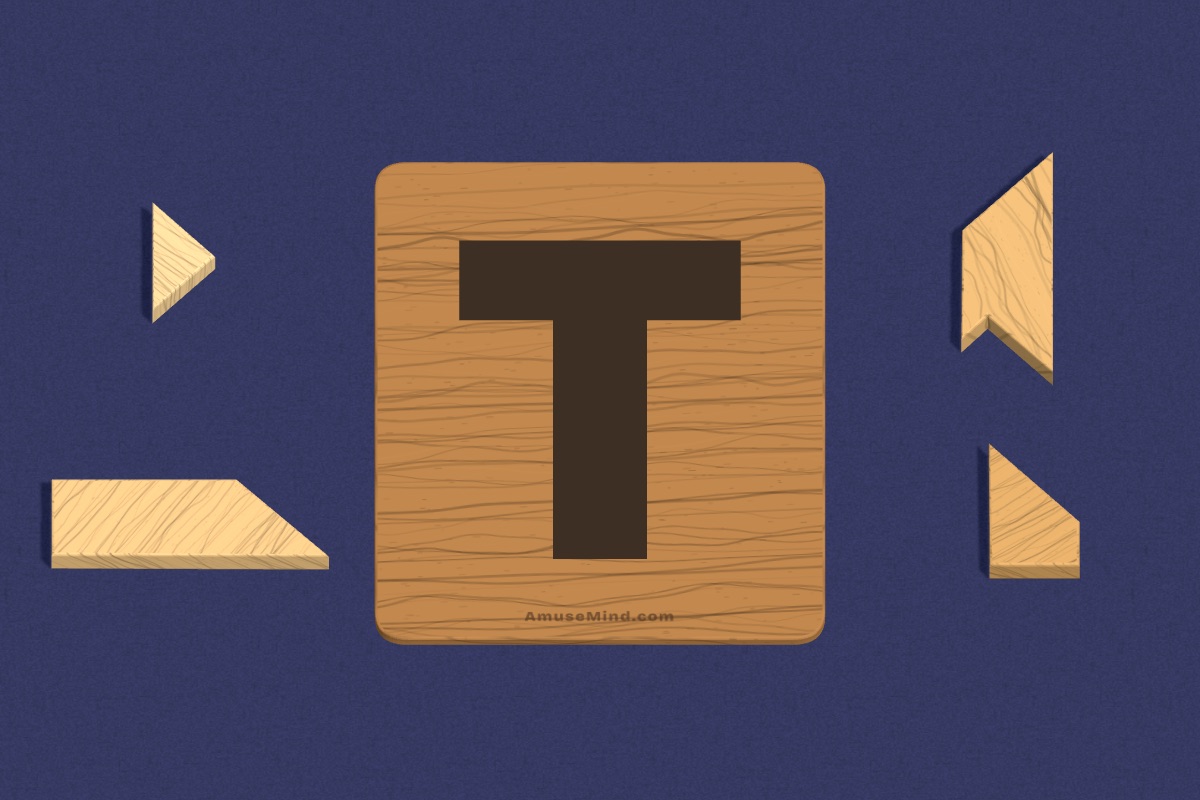
The T puzzle has just four wooden pieces, and they make a capital T. It sounds easy. Many adults spend a long time on it, which is exactly why children love beating it.
The pieces
The classic set has four pieces cut from a T with straight cuts at 45 degrees: a small triangle, two trapezoids of different lengths and an odd five-sided piece with a notch cut into it. Every edge runs either straight or at a diagonal.
Why it’s hard
Most people pick up the five-sided piece and try to fill its notch with another piece, because a gap looks like something that needs filling. That instinct leads away from the answer. The breakthrough is realising that not every gap needs filling: in the T, the notch sits where it forms part of the outline.
It is a lovely example of how our first idea can trap us, and how trying the piece a different way round, or at a different angle, opens up new possibilities.
Easier shapes first
The same four pieces make dozens of other shapes: arrows, a chevron, a boat, a bird, a long bar. Many of these are much easier than the T and teach how the pieces fit together. AmuseMind puts these first and saves the T for the Demon level.
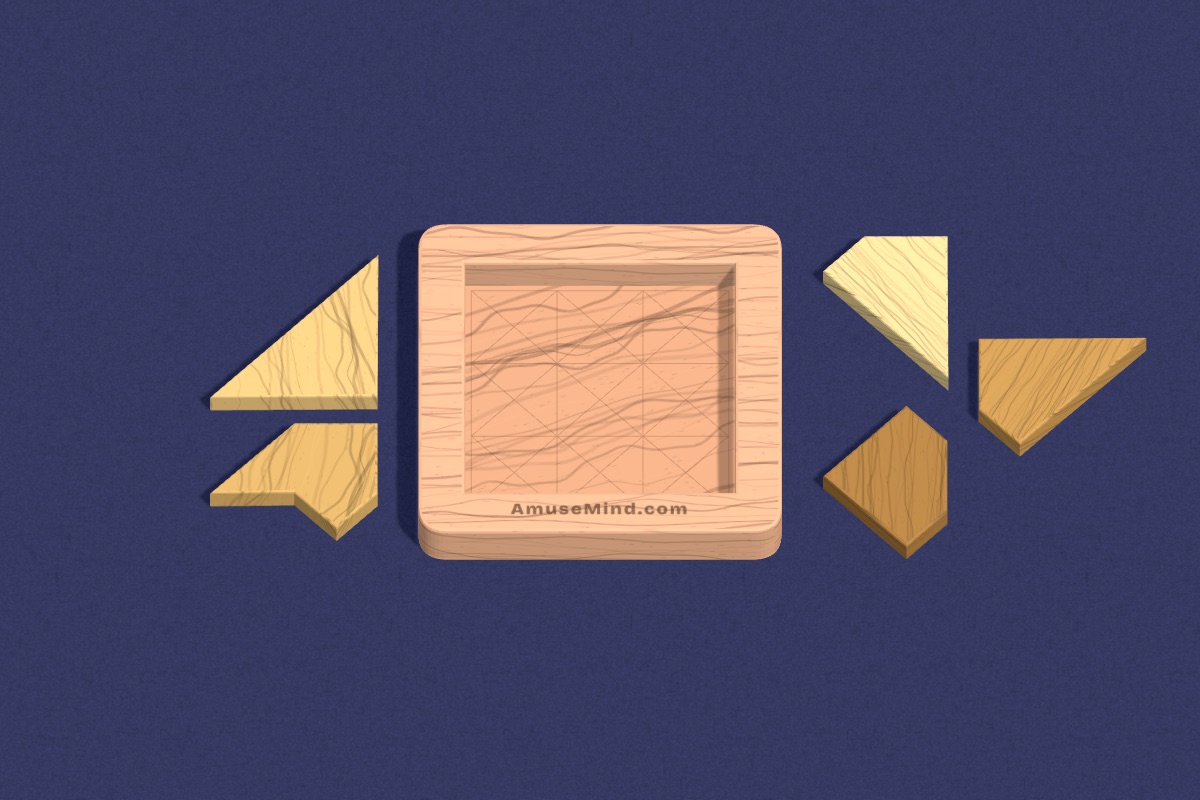
AmuseMind also includes Square Four, a simpler set of four pieces cut from a square, as a gentle opener for younger players.
Helping without solving
If your child is stuck, ask questions rather than placing pieces. “Does every piece have to sit straight?” and “What if that gap stays open?” are good nudges for the T. Encourage them to turn and flip each piece, since a piece flipped over can look like a completely different shape.
Beginner and Intermediate show piece outlines inside the shape, which suits six and seven year olds. Pro shows only the silhouette, and Hacker and Demon start some pieces flipped the wrong way.

Thinking skills behind the T
The T puzzle is a favourite example of what psychologists call fixation: getting stuck on one way of seeing a problem. The cure is to deliberately try something that feels wrong, like turning a piece to an odd angle or leaving a gap open, just to see what happens.
Children can practise this habit on easier shapes. When a figure isn’t working, encourage them to take every piece out and start with a different piece in a different place. That fresh start often solves it.
Talking about “getting stuck on an idea” is useful well beyond puzzles. A child who learns, with a T puzzle, that their first idea isn’t always the right one has picked up a habit that helps with maths problems, writing and building things.
Square Four, the gentler four-piece set in AmuseMind, uses the same thinking with simpler shapes, making it a good warm-up before the T figures.
Questions parents ask
Why is the T puzzle so hard?
Because people instinctively try to fill the notch in the five-sided piece. The solution comes from leaving it open and trying the piece at an angle.
How many pieces are in the T puzzle?
Four: a triangle, two trapezoids and a notched five-sided piece.
What age is the T puzzle for?
Easier shapes suit children from about six; the T itself is a challenge for older children and adults.
What other shapes can the T puzzle pieces make?
Dozens, including arrows, a chevron, a sailing boat, a bird, a parallelogram and a long bar. AmuseMind has over 30 figures, with the T itself saved for the hardest level.

