Peg solitaire is a board of pegs and holes where you jump pegs over each other until, if you’re clever, only one is left. In India it’s often called Brainvita; in the US you may know it as Hi-Q.
The rules
A peg can jump over a neighbouring peg, straight up, down, left or right, into an empty hole just beyond. The peg it jumps over is removed. You keep jumping until no jumps are left. Finishing with a single peg is a win; finishing with one peg in the centre hole is the classic perfect finish.
The traditional English board is a cross shape with 33 holes. It starts with 32 pegs and only the centre hole empty.
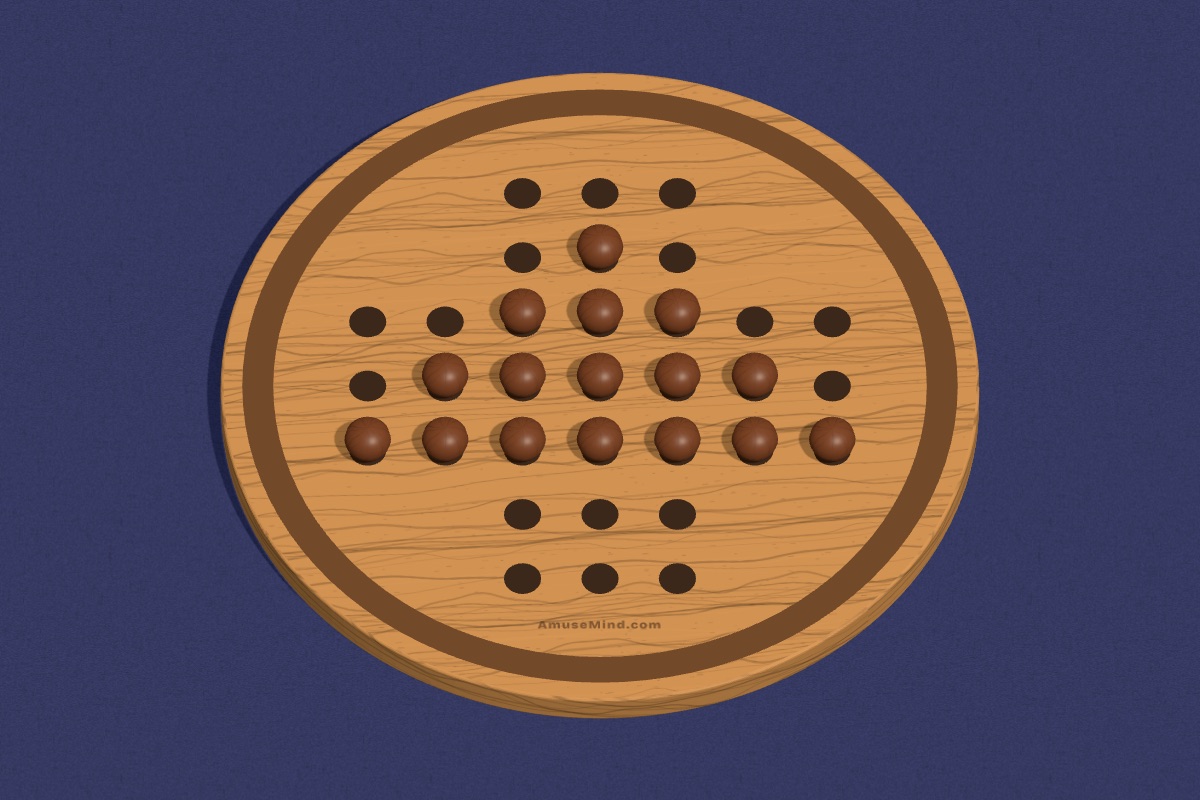
Why the full board is hard
Every jump removes one peg, so a full puzzle is exactly 31 jumps. The difficulty is that pegs left alone in a corner, with no neighbour to jump over or be jumped by, can never be removed. Most failed puzzles end with a few stranded pegs far apart.
Strategies that help
Keep the pegs together. Before each jump, check you are not leaving a peg isolated. Clearing the board in tidy blocks works much better than jumping wherever you can.
Clear the arms of the cross one at a time. Each arm of the board is a small area that can be emptied with a few well-ordered jumps, pulling its pegs back towards the middle.
Leave the centre until the end. The last few jumps all happen near the middle, so keep pegs there as a reservoir to finish with.
Look for packages: little groups of three pegs in an L or a line that can be cleared with a set pattern of jumps. Finding these makes big boards much more manageable.
Start small
The full board is a lot for a seven year old. Smaller starting patterns teach the same moves with far fewer pegs. AmuseMind’s Beginner is a small cross of six pegs, Intermediate a plus of nine, Pro a pyramid of sixteen and Hacker a diamond of twenty-four, and Demon is the full 32-peg board. Every level is proven to be solvable down to one peg in the centre.
If a puzzle goes wrong, use Undo to step back a few jumps and try a different order. Spotting the jump that caused the trouble is how children get better.


Making it a learning puzzle
Peg solitaire is a good puzzle for talking out loud. Ask your child to say which peg they will jump and where it will land before they move. That small pause turns random jumping into planning.
Try ending positions. Set a goal like “finish with one peg anywhere” first, then “one peg in the centre” once that feels easy. AmuseMind’s levels all finish in the centre, which is the classic challenge, but any single peg is worth celebrating at first.
Notice the patterns. After a few puzzles, children often see that clearing a line of three pegs needs a particular sequence of jumps. Encourage them to name these little patterns; recognising them is what makes the full board possible.
Use Undo without guilt. Going back a few jumps to try a different order is exactly how strong players learn, and it keeps the puzzle fun rather than frustrating.
Questions parents ask
Is peg solitaire the same as Brainvita?
Yes. Brainvita, Hi-Q and solo noble are names for peg solitaire.
How many moves does it take to solve peg solitaire?
On the 33-hole English board every puzzle is 31 jumps. Counting a chain of jumps by the same peg as one move, the shortest known solution has 18 moves.
What age can children play peg solitaire?
Small patterns suit most seven year olds. The full board is a good challenge from about ten.

