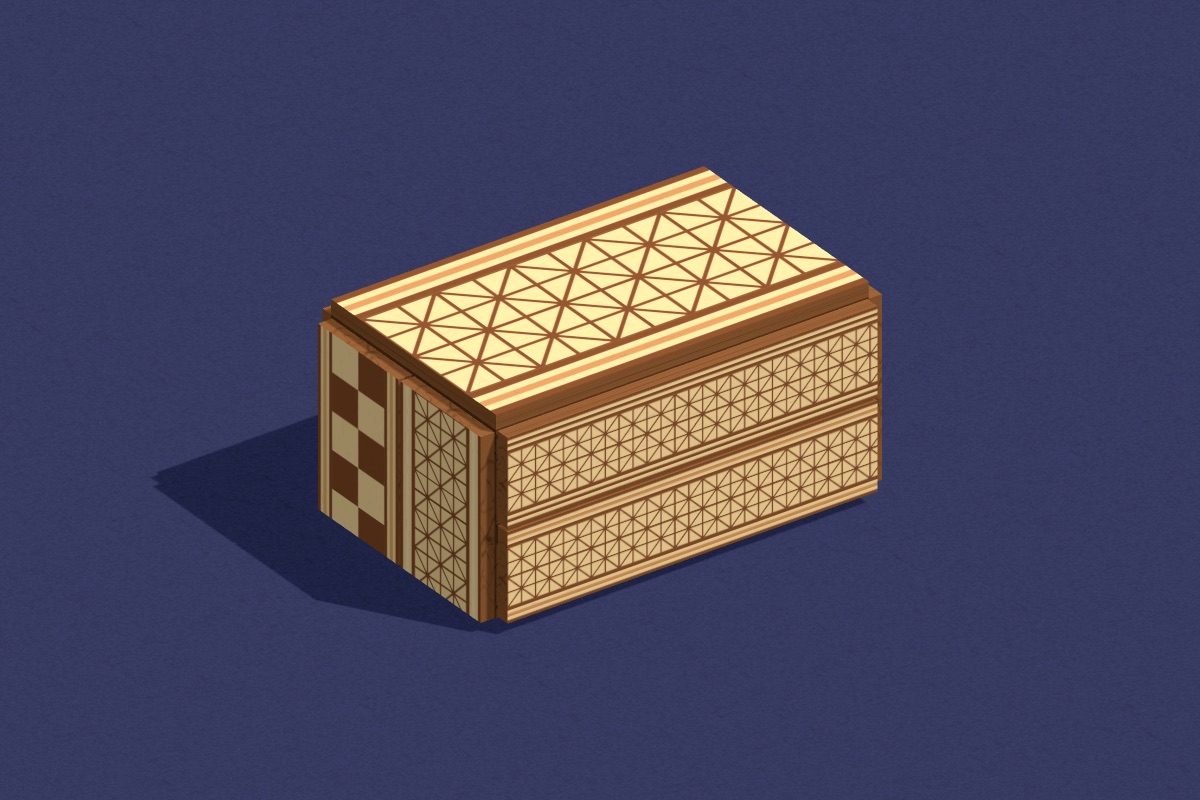
Himitsu-bako, “secret boxes”, come from the Hakone region of Japan. They look like ordinary wooden boxes covered in mosaic, but they only open when their hidden panels are slid in exactly the right order.
What makes them special
Traditional boxes are covered in yosegi, a wooden mosaic made by gluing strips of different woods together and slicing thin patterned sheets. The pattern hides the seams between panels, so you can’t see which parts move.
Boxes are often described by the number of moves needed to open them. Simple boxes take four moves; elaborate ones take dozens.
Why the order matters
Each sliding panel is held by another. A side panel can only slide once a panel above it has moved; the lid can only come off once the right panels are clear. This chain of locks is what makes the box a puzzle and not just a box with a trick lid.
In more advanced boxes, a panel must slide one way, then later slide back, to let something else move. That is why the move counts can be so high.
How to approach one
Test every panel gently. Most won’t move. When one does, stop and look at what it might have freed, then test the panels around it.
Keep track of what you’ve tried. Many people get lost not because the box is hard but because they forget which panels they already moved. Saying moves out loud (“top slid left, then front right”) helps children remember.
Turn the box over. Panels on every face are part of the sequence. In AmuseMind you drag the table to turn the box and see each side.
What children learn
Puzzle boxes are a gentle lesson in cause and effect: this move made that move possible. They also reward memory and patience. Locked panels in AmuseMind give a small clunk instead of moving, so children know immediately to try something else.
AmuseMind’s boxes are generated fresh each time: Beginner opens in 4 moves and suits six year olds, while Demon boxes take more than 20 and need panels moved back and forth.

Making your own sequence puzzles
You can play with the idea of a sequence lock without any special equipment. Line up a few cups and set a rule: cup B can only be lifted after cup A, cup C only after B has been put back. Children quickly see how a few simple rules create a puzzle with a long solution.
This is also a good way to talk about why some steps have to be undone. In the cup puzzle, putting B back to free C mirrors exactly how an advanced puzzle box makes you slide a panel back to let another move.
When children are ready for something harder, try Luban Lock or Klotski. Both share the same lesson as puzzle boxes: progress sometimes means stepping back, and remembering what you have tried is a powerful tool.
Questions parents ask
What is a himitsu-bako?
A Japanese secret box from Hakone that opens only when hidden panels slide in the right order.
How many moves does a Japanese puzzle box take?
Simple boxes take about four moves; complex ones can take dozens.
What age are puzzle boxes for?
Simple boxes suit children from about six; longer sequences suit older children who can keep track of their moves.
Can you open a puzzle box by force?
You shouldn’t: real boxes are delicate and the fun is in finding the sequence. Gently testing each panel is always the way in.


