Block design puzzles give you a set of cubes with black, white and half-black faces, and a card with a picture to copy. Line up the right faces, turned the right way, and the picture appears on top of the blocks.
How the blocks work
Every cube has the same six faces: usually some all white, some all black and some split diagonally into a black and a white triangle. Because every cube is the same, it doesn’t matter which cube goes where. What matters is which face is on top and which way it is turned.
In AmuseMind, you tap a block to turn its top face and swipe to roll it onto another face. Beginner cards are 2 × 2; Demon cards are 4 × 4 and add faces with black bands, points and corners.
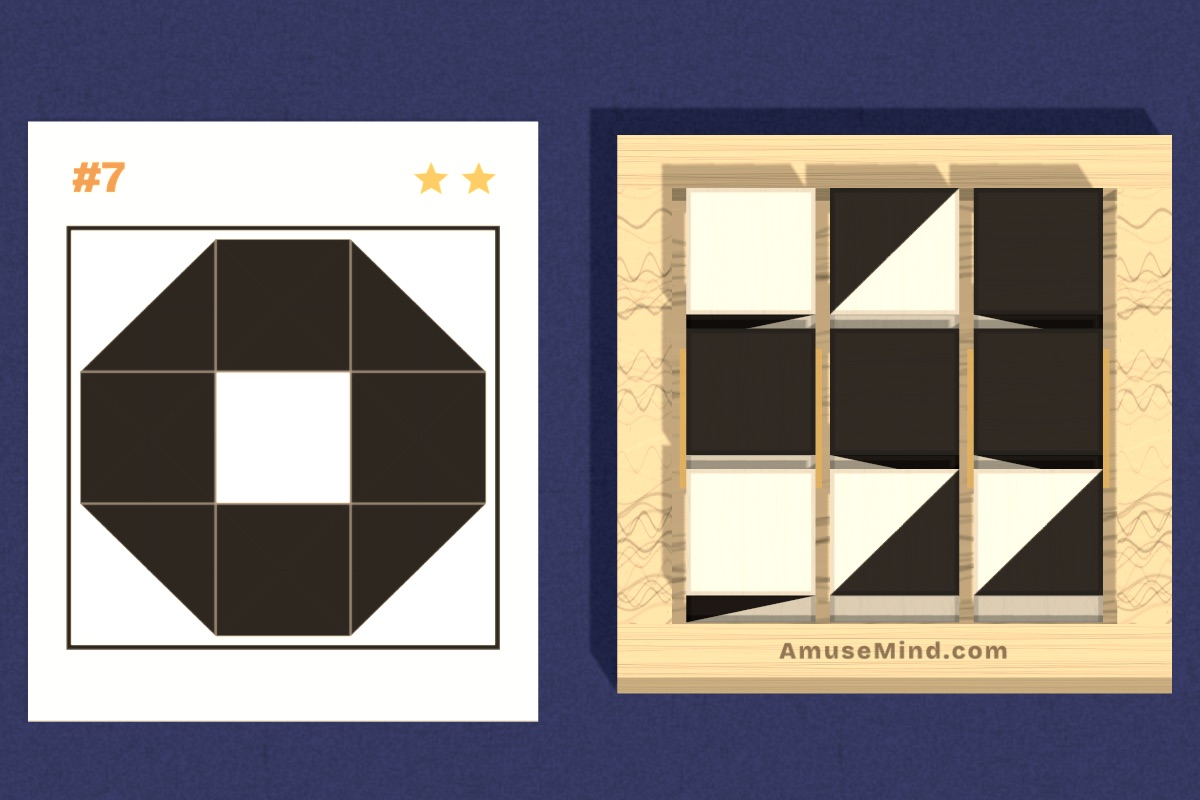
Step 1: see the grid
The card shows one big picture, but it is really a grid of small squares, one per block. The first skill is mentally drawing those grid lines. Beginner and Intermediate cards in AmuseMind draw the lines faintly to help; harder cards leave them out.
Step 2: easy squares first
Find the squares that are all black or all white and set those blocks first. They need no turning, only the right face. Then move to the diagonal squares, the ones split into a black and a white triangle.
Step 3: get the turn right
A diagonal face can point its black corner four ways. Look at which corner of the square the black triangle fills, then turn the block until it matches. Children often get the face right but the turn wrong; checking each corner against the card fixes this.
AmuseMind lights up a block when it matches its square on the card, so children get instant feedback on each part.
Why it’s worth doing
Seeing a whole picture as parts, and rebuilding the whole from those parts, is a core spatial skill. It also builds careful checking. Children from five can copy 2 × 2 cards; by nine or ten, 4 × 4 cards with tricky shapes are a real challenge.

Activities to try at home
You don’t need special blocks to start. Paper squares coloured all black, all white and half-and-half on the diagonal work well. Lay out a simple 2 × 2 pattern and ask your child to copy it with their own squares.
Take turns being the designer. Children love making patterns for an adult to copy, and designing a pattern teaches as much as copying one, since they have to think about which pieces make which shapes.
Look for patterns in the world. Tiles, quilts and windows often use the same black-and-white triangle shapes. Spotting them on a walk turns everyday things into small puzzles.
AmuseMind’s Hidden Blocks offers numbered cards from one star to five, so children can track their progress from simple diamonds to crosses and octagons. Cards are generated fresh, so there is always a new design to try.
Questions parents ask
What is a block design puzzle?
A puzzle where you arrange cubes with black, white and half-black faces to copy a pattern card.
What age is block design for?
Simple 2 × 2 patterns suit children from about five; 4 × 4 patterns suit older children.
Does it matter which block goes where?
Not if every cube has the same faces, as in AmuseMind. Only the face on top and its turn matter.
How do you rotate a block in Hidden Blocks?
Tap a block to turn its top face a quarter turn, and swipe across it to roll the cube onto a different face. Undo is always there if a move goes wrong.

